I keep written lists of the books that I read every year, both to keep track of the number (my goal is always 50, but I rarely achieve it) and to mark how much I liked it. I give each book a letter grade that is partially based on my evaluation of its quality, but is mostly based on my personal enthusiasm while reading it. I’ve been doing this for years, and I continually think, I should really post about the A and A+ books. And then I don’t do that, because I am doing things like finishing a PhD, commuting 80 miles to teach 80+ students, trying to start an independent educational venture (and YouTube channel!), and/or wedding planning. Or, you know, writing and editing my own novel manuscripts. So the book reviews do get back burnered, is what I’m saying.
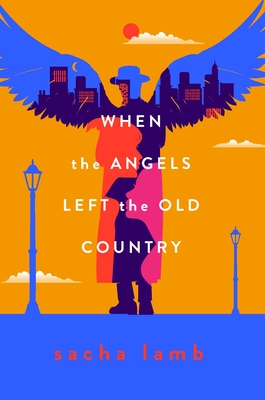
But talking about books and especially trying to get people to read books that I think are good is truly one of life’s great joys, so I’m going to try to make some more space for it. So I’m going to begin with a discussion of a book that has personally brought me a lot of joy: Sacha Lamb’s When the Angels Left the Old Country.
In this book, an angel and a demon study together in a shtetl so small it’s simply called Shtetl. The angel, whose name changes along with its singular task, and the demon, Little Ash — short for Ashmedai, after his father — enjoy arguing about Talmudic interpretation while the rather sleepy village life unfolds around them. But, here at the beginning of the twentieth century, change is inevitable, and some of Shtetl’s inhabitants have begun to emigrate to New York. One such emigrant is Essie, a young woman who has been dutifully communicating with her father — until suddenly she stops. Little Ash, curious and eager for opportunities to see more of the world and its mischief and wrongdoers, wants to investigate; he manages to convince the angel to go with him, though of course not on those grounds.
Meanwhile, an ambitious and somewhat pushy teenager named Rose in a nearby village is also preparing to make for New York. She intends to go with her best friend, Dinah, and feels utterly betrayed when Dinah gets engaged instead. To a man! Rose does not know how to interpret these Very Big Feelings yet, but she sets off alone, stubbornly trying to ignore her heartbreak.
On their journeys, Little Ash, the angel, and Rose encounter con artists taking advantage of immigrant desperation, Christian demons who prowl Ellis Island, and a time-sensitive mission from a ghost to inform his family of his passing before he becomes a dybbuk. The angel also picks up a name, Uriel — well, he does need a passport — which makes him more human and therefore more vulnerable.
Once in New York, they encounter even more corruption and abusive labor practices, opposed by the Jewish immigrant union community that they join. Rose joins the efforts to rescue Essie, who, she can’t help but notice, is awfully pretty. Spoiler alert, Rose eventually makes the discovery about herself that she needs to make, and it feels like “she was standing at Sinai, receiving the word of Heaven, a responsibility so huge that one could hardly imagine it.”
Meanwhile, Little Ash worries about the ways in which Uriel is changing, and whether or not he’s gotten the angel in over its head. At the same time, Uriel learns what it means to feel fear and anger and other human things like that — but also what it means to love creation like a human instead of an angel, close up and limited but also focused and passionate.
Also, if you couldn’t tell, Little Ash and Uriel love each other so much.
Sacha Lamb’s writing is a joy to read; it feels like listening to your most witty and poetic friend tell you a story. The characters are strong and highly individualized in voice and personality, though one thing the three main characters often have in common is a certain lack of self-awareness about their own feelings, which just so happens to be one of my favorite genres of fictional character. When authors can communicate an emotional landscape to the reader that the character themself has very little insight into: delicious. Lamb also doesn’t spoonfeed explanations of the Jewish historical and cultural references; you either get them or you don’t, but either way, they clearly inform the rich social and inner worlds of the characters.
I myself am not Jewish, but my beloved is, and one thing we love to do is learn together. From this point on, my account of this book is not going to even pretend to be an objective review, because the experience of reading it was so particular and beautiful for me. I read When the Angels Left the Old Country aloud to Marissa. We experienced the story together at the exact same time, sharing every moment of this work of art. The ways in which it felt personal to her became, in turn, personal to me. She noted how sometimes we’d run into a sentence so long that you could run out of breath before finishing it, which reminded her of the way her family talks. She corrected and complimented my Yiddish pronunciation by turns.
We finished the book in our backyard two springs ago, underneath a huge magnolia tree in full bloom. The tree has since been cut down, because our property management company didn’t want to … well, manage the property. In its absence, however, our garden has sprung up into a riot of weeds and ferns and flowers. Some of the flowers we’ve planted, but some just appeared. We had bright red poppies in June. Now, we have tomatoes and a squash plant that we did not put there. We’ve just let nature do its thing; our only goal was to provide a place that bees would enjoy. Now every time we brave the little urban thicket, we wonder what new life we’re going to find. Little Ash might find it boring, but I think Uriel would appreciate it.
In October, we will include a reading from When the Angels Left the Old Country at our wedding.
Little Ash and Uriel are each other’s chevrusa, partners in study and learning. They argue with each other about text and meaning. They wonder together; they discover together. What could be a more sacred bond?
I am so lucky to have found my chevrusa, and to have shared this story of two fellow learners with her.
 Kathleen Kellett