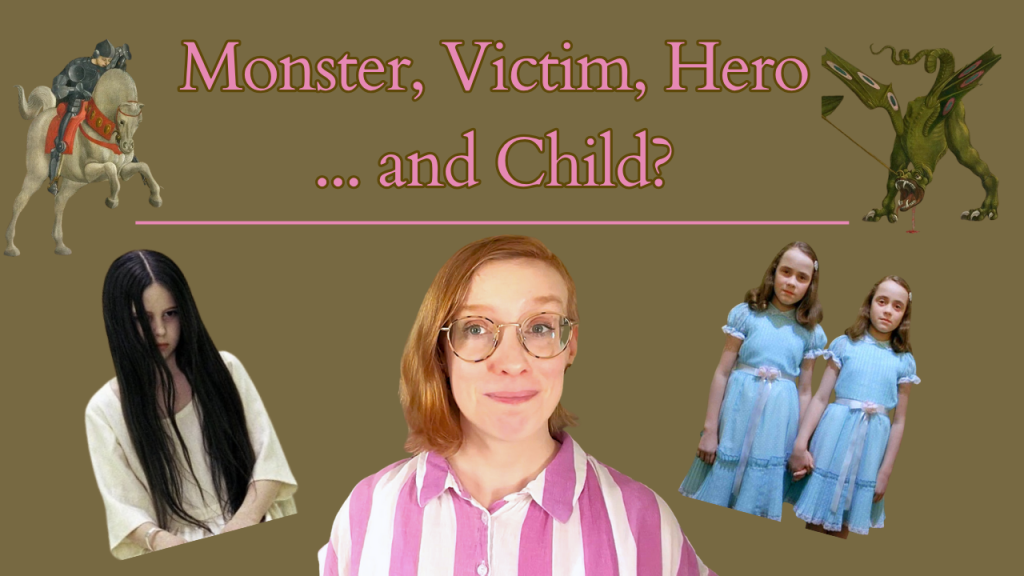
Link to video: https://www.youtube.com/watch?v=aEfOfntB3Xs&t=4s
INTRODUCTION
Hello, and welcome to The Monster & The Child, where Childhood Studies and Monster Studies collide! I am Dr. Kathleen Kellett, and this video is Monsters 102: Monster, Victim, Hero – and Child. If you haven’t yet watched my Monsters 101 video, which was about understanding monstrosity as the antagonistic opposite of humanity, you don’t need to in order to watch this one, but I certainly recommend checking it out once you are done here. Link to that video is in the description, along with a link to this video’s transcript, as well as all the sources and media I will be citing here today.
Just as a quick recap, though, last time we talked a lot about how monstrosity functions metaphorically. One way of understanding what a monster is is as a symbol of everything that disqualifies a being from humanity – physically, geographically, morally, behaviorally, etc. The monster is the thing that breaks the rules of human society: therefore, as many monster scholars have posited, we can learn a lot about a given society’s definition of humanity by studying its monsters and working backwards. A human will be everything the monster is not, and vice versa.
But monsters don’t exist as just static figures. As I mentioned in my previous video, Godzilla is not a monster until it attacks; before that, it’s just a funky aquatic creature. Monsters are narrative figures. They exist within narrative frameworks: in “monster stories.” And they are not the only character in that story.
Now, disclaimer: not all monster stories follow the same pattern; there will be wild cultural variations. I, once again, will be exploring a narrative type that is particularly common in Western modes of storytelling. This is not to say that non-Western stories lack the archetypes I will be discussing; just that there are a lot of nuances when it comes to cultural relationships with monsters, so I don’t want people to take this analysis as the be-all-and-end-all of monster stories.
With that said, when you encounter a monster story, you are likely to also encounter a hero and a victim. Actually, when we’re dealing with monsters as antagonists, you’re always going to encounter a victim. In order to be defined as a bad type of monster (as opposed to, like, Elmo), the monster needs to take action against humanity. So monsters and victims are like – I was going to say peanut butter and jelly, but it’s more like the jet fuel and engine of a plane: the narrative can’t take off if one of them is missing.
As for where heroes come in, that will depend on the story. Sometimes we tell stories where no one rises to defeat the monster. The monster wins, and hope is lost. Horror has no obligation to be optimistic. But, oftentimes, we want our side to come out on top. By stepping up and opposing the monster, heroes position themselves as not just as representatives of humanity, but the pinnacle of it. If monstrosity is a failure of human ways of being, then heroism is the best humaning you can possibly do.
Let’s take a look at an example from legend: St. George and the dragon. As with any centuries-old mythology, there will be variations, but one of the most popular versions is the one recorded in Jacobus de Voragine’s thirteenth century text “The Golden Legend.” In this story, a town is menaced by a nearby dragon which “envenomed all the country.” Various men of the town have ventured forth to oppose him, but they’ve all chickened out once they saw the beast. The dragon has the ability to poison the whole population with his breath, so to avoid this, the townspeople deliver a couple of sheep a day to keep him fed and nonviolent. Kind of a dragon-as-mob-boss vibe going on. Unfortunately, the sheep supply is not infinite, so the town has to start supplementing the offerings with people. Specifically, the “children and young people” of the town draw lots to be the victims. We’ll put a pin in that for right now and return to it shortly.
Eventually, the king’s daughter draws the lot. The king “arrays his daughter like as she would be wedded” and, grieving, sends her to her fate. But luckily along comes St. George, who asks the princess what she’s doing in the wilderness by herself. The princess tells St. George to leave so he does not get killed alongside her, but when the dragon appears, St. George “garnished him with the sign of the cross” then stabs him with his spear. St. George tells the princess to use her girdle to leash the dragon, and with that, the monster is defeated, and the princess is saved.
The roles in this story are very clear: dragon is monster, princess is victim, St. George is hero. The first one definitely makes sense: Ol’ Extortion McPoisonBreath is definitely breaking some of the physical and behavioral rules of engagement here. But why doesn’t St. George play the role of the victim, and the princess the hero?
To that, I’m sure you’re responding, yes, Kathleen, I get it, we know, but just to state the obvious: victimhood relies on associations of vulnerability, whereas heroism is tied to associations of strength. Therefore, we can learn a lot about the social hierarchies of any given society by looking at who plays these roles within their monster stories. The princess is young and female; St. George is Christian and male. It is the responsibility of the latter to protect the former. If that doesn’t leave a lot of room for individual agency for either of these figures – well, that’s kind of how archetypes work.
A useful way of understanding these archetypes within the structures of a narrative is to return to scholarship on metaphor. In my last video, I talked about George Lakoff and Mark Johnson’s theory of “conceptual metaphor,” in which metaphors organize our general understanding of an idea. To provide a different example than I did last time, think about the basic directional connotation of up and down. If you’re “feeling down,” you’re depressed – and, oh damn, “depressed” itself is a directional metaphor, like a depression – an indent, a hole, a downward slope – in the earth. That one is really baked into our language and therefore our general understanding of the actual space around us, even though there is not any literal correlation to these spatial dimensions with positivity or negativity. So you can see how powerful metaphor can be, even when you don’t notice it at all.
Now, monsters are not as covert as directional metaphors. When you’re talking about an evil dragon, you kind of know that you’re dealing with some symbolism, more so than you do when you say you have an “elevated” mood. Nevertheless, these patterns in our language and storytelling still wield immense influence over how we view the world.
Looking more at the narrative dimension of all of this, we can dip into the work of Dr. Jonathan Charteris-Black, who has published a great deal of work on metaphor in political rhetoric. He argues that metaphor allows us to “identify underlying ideologies and expose the nature of the value systems on which they are based” (p. 198). These ideologies and value systems are often particularly evident through a metaphor’s associated concepts, and how these coalesce into common cultural narratives. Charteris-Black demonstrates this idea through his discussion of the “journey” metaphor that many politicians employ, especially during their campaigns. “It’s been a long road,” but they’ve “come so far,” and soon they will “arrive” at a position from which the politician can deliver on their policy promises. This seemingly simple metaphor — political activity as traveling to a destination — can take on a whole narrative life of its own. The “journey” that politicians invoke in the minds of their constituents is not just a trip from point A to point B, but rather the hero’s journey, a narrative that Charteris-Black explains is culturally stocked with “heroes, victims and villains.” And I think we can slot in “monsters” for “villains” there, even if those archetypes aren’t quite synonymous. Charteris-Black also spells out the hero’s journey’s associations with “protection of the family, loyalty to the tribe, fear of invasion by an unknown other” (Charteris-Black, 2011, p. 203). So we can see metaphorical that replacement of one concept for another – politics for journey – does not stand alone. Instead, it exists within a whole narrative framework.
Returning to our monster stories: when we invoke a monster, we also call up associations of the other characters in the story – the victim and the hero. We place these figures into a hierarchy of power and vulnerability. If the dragon is just chilling in its cave, it’s not much of a monster. What makes this monster opposed to humanity? To answer that question, we can turn to what kind of harm it causes to its victim, the princess, and what kind of hero – a knight and a saint – can save the day. Monsters are always defined by their narrative relationships to these figures. The monster is the figure that has too much power that it uses incorrectly; the victim is the figure that lacks power; and the hero is the figure who has a lot – but not too much – power, used properly. We can glean a ton of cultural information from examining the specifics of those power differentials in a monster story from a specific time or place.
THE CHILD AS VICTIM
So if we add the child into our monster-victim-hero equation, there is an obvious place where they would fit. We already saw it in the legend of St. George: the young people of the town are delivered over to the dragon. Monsters and heroes are both imagined with a lot of power, whereas victims have very little. And children frequently don’t have a lot of power.
In my last video, I talked about how there are very few universals when it comes to human cultures. This goes for some of the most basic organizing principles of humanity that, within our own cultures, we tend to take for granted as natural and self-evident: morality and values, family structure, gender, etc. This is also true of childhood. Now, obviously there are some biological facts about childhood that hold true regardless of culture. Babies start small. When they are born, they are not yet capable of using language or moving from one place to another by themselves. Many children develop these cognitive functions and motor skills as they get older and larger. With these changes also come changes in the way many children process and participate in the activities, relationships, emotions, and values of their society. (I said many and not all for a reason, though we’re going to put a pin in that one, as well. I have a future video about monstrosity, childhood, and disability planned, so remember to subscribe if you’d like to pick up that conversation with me down the road.)
So yes: biologically, bodies and brains start in one place at the beginning of life and go through a procession of changes. But how do human societies collectively make sense of those processes? That’s where the cultural variation comes in. Are children naturally moral or naturally sinful? Are babies a blank slate or do they possess special knowledge? Do they belong primarily in their own institutional spheres of society or should they be integrated within social groups of multiple generations? Who should be in charge of overseeing and directing the changes a child undergoes from infancy to adolescence? The answers to these questions constitute a given culture’s social constructions of childhood.
Oftentimes, our beliefs and ideas about childhood blend the biological and the social. One example is the association of childhood with vulnerability. Small children are literally more vulnerable to certain types of harm than adults on account of things like size and motor control. If I see a car speeding towards me, I have a better chance of leaping out of the way now than I did when I was two. I also have more experience with, for example, the concept of dishonesty now than I did in elementary school, so I can recognize the millions of spam texts I receive for what they are, whereas if I read them when I was six, I’d probably think I really did need to give my bank account info to the unknown number who was asking for it. This is part of the reason I didn’t have bank account info when I was six, as well as the reason I was not allowed in the street when I was two. Children’s lives are dictated in large part by adult efforts to reduce their vulnerability to harm – but how we identify that harm is frequently socially constructed and specific to a time and place.
The potential failures of these adult safeguards in response to children’s vulnerability is, understandably, a source of great anxiety. This makes the topic excellent fodder for monster stories. Monsters often don’t just represent individual danger, but rather danger to the entire fabric of society. “Keeping children safe” is something that society places a very high value on. Does this mean we actually do that well? Not necessarily. But it is important to us, important enough to be integral to our definition of what it means to be human. A child victim succumbing to a monster reflects social fears about the breakdowns of the systems and institutions that we have established to keep children safe – and therefore the breakdown of humanity in general.
Let’s take a look at a classic horror story: The Shining. Now, I’ve both read the King novel and seen the Kubrick film adaptation, though I’ve done the latter much more recently than I have the former. (My strongest memory from the book was reading it home alone during a thunderstorm, the power going out, and being very sure I was about to die.) It’s worth noting that the original and the most famous adaptation are quite different, so the treatment of the topic of the child’s vulnerability will vary based on which one you’re engaging with. I’m going to focus mainly on the film.
The Shining follows the Torrance family’s ill-fated stay at the Overlook Hotel. The family consists of father Jack, mother Wendy, and son Danny. Jack is a (barely) recovering alcoholic who is looking for a fresh start after losing his job and accidentally breaking Danny’s arm before the start of the story. He takes on the role of caretaker of the hotel during the winter months when it is closed. For most of this time, the family can expect to be completely snowed in and isolated.
When the family arrives at the hotel, the Overlook’s chef, Dick Hallorann, takes Danny aside. Turns out, Danny’s unsettling insights and relationship with his “imaginary” friend Tony are not just his imagination. Danny, like Hallorann, has a psychic ability that Hallorann calls “the shining,” which gives him powers of telepathy and visions. The Overlook, unfortunately, is not a great place for a kid with the shining, because it seethes with the psychic and ghostly residue of past violence and calamity. So, you know, have a nice winter!
Now, in some ways, because of the shining, Danny does have more power than an average small child. However, due to his age, this power is not something he knows how to control yet – and, in fact, it makes him even more vulnerable to the malevolent energy of the Overlook. But Danny was already vulnerable before he got here: vulnerable to his father.
Because that’s the thing about vulnerability, isn’t it? You have to be vulnerable to something. Identifying vulnerability requires identifying a danger. Just like a monster can’t be a monster in isolation, a child can’t be vulnerable in isolation, either.
As we established, Danny has already experienced abuse at the hands of his father. Though Jack is attempting to change his ways, he still presents the greatest danger to his powerful – but not powerful enough – son. Danny’s vulnerability is emphasized by two ghost girls who died in the Overlook at the hands of their own father. These girls are decked out in the frilly trappings of innocent girlhood, making their creepy ghostly invitation to Danny to “come play with them” all the more unsettling – and the subsequent vision they induce of their dead and bloodied bodies all the more horrifying. Though these girls are now monstrous themselves as ghosts of the Overlook, it is only their vulnerability and resulting victimhood to their father’s violence that made them so.
This story is about the breakdown of the nuclear family unit, which in mainstream American culture is the number one social institution that is supposed to maintain the safety of the child. More than schools, medical services, social services, the nuclear family is enshrined as the child’s ultimate guardian and protector.
This is one of those things that, to many people within this culture, seems natural and objective, but is actually extremely socially constructed. We can see some evidence of this in the US’s relationship to the United Nations Convention on the Rights of the Child. The UNCRC is an international treaty that was developed and signed in 1989. As the name would suggest, it details the UN’s vision of the fundamental rights of children, regardless of nation or circumstance. The main tenets of this document are non-discrimination, the child’s right to life and safety, the child’s right to be heard, and prioritizing the “best interests” of the child. Now, of course, there is a ton of disagreement about that last one, because what is considered in a child’s best interest is also extremely culturally-dependent. Much ink has been spilled about the practicalities and ethics of a universalizing document like the UNCRC, and these conversations are not at all settled. However, it is worth pointing out that all member nations of the UN have ratified this treaty except for one – the United States.
That’s not to say that all member nations keep to the terms of the treaty; see the existence of child casualties in war. But literally everyone else is down to at least pay lip service except for the US. Why is that? Well, some of it has to do with the way our government is set up; ratifying a treaty requires a two-thirds majority in the Senate. The U.S. also historically has, let’s say, issues with any perceived threat to its own sovereign decision-making, and there is conservative opposition to not just the UNCRC but many other examples of international influence over domestic policy. Does this attitude square with the power the US wields both within the UN and otherwise when it comes to other nations’ policies? I would perhaps argue no, but I’m just reporting on the rationale.
But it’s not just our “independent nature” that stops us on this one. One big argument is that the UNCRC interferes with parental rights. The Parental Rights Foundation, which boasts a former US representative among its board members, argues that by declaring that “the best interest of the child shall be the primary consideration,” the UNCRC puts the determination of that best interest in the hands of the state instead of parents. The Home School Legal Defense Association has expressed concerns that the UNCRC, in its emphasis on the child’s “right to be heard,” would allow the child to reject familial religious instruction and schooling. They have also opposed perceived threats to parental “rights” to use corporal punishment.
I’m not pretending to be unbiased here, as you can already tell. And it’s important to note that a lot of these objections are disingenuous at best; on top of obviously not becoming more powerful than state and federal law because that’s not how UN treaties work, the UNCRC does not strip parents of their rights. An archived post from the Children’s Rights Campaign explains “The Convention repeatedly emphasizes the pivotal role parents play in their children’s lives. It recognizes the family “as the fundamental group of society and the natural environment for the growth and well-being of all its members and particularly children…”, and acknowledges “that the child, for the full and harmonious development of his or her personality, should grow up in a family environment, in an atmosphere of happiness, love, and understanding.”
No one in the UN is dismantling the institution of the family – or the nation-state, for that matter. But the fear – or fear-mongering – that it could has been successful enough to let the United States stand alone as the only non-ratifying member nation, and I don’t think we should be surprised by that. Parental rights as a political rallying point are having a significant moment. Trump named his executive order to dismantle the Department of Education “Improving Education Outcomes by Empowering Parents, States, and Communities.” It’s not an accident that parents are first in that list. In American cultural constructions of childhood, of family, of the guardianship of children’s vulnerability, parents are the ones in our cultural stories about childhood who are positioned to play the role of the heroes: lots of power, used correctly, to protect the vulnerable victim. Indeed, the tagline of ParentalRights.org is “protecting children by empowering parents.” But protect them from what?
Monster stories are one means of collectively seeking to identify the threats that “vulnerability” and “protection” require. And while some monster stories may reassure us by enshrining the parent’s role as the hero who vanquishes the monster, others, like The Shining, disturb us by showing just how much more vulnerable a child can be when the parent is the monster himself. (See, I brought it back to The Shining from the UNCRC!) As viewers, we are primed to see Danny as a perfect victim, absolutely powerless in the face of this misused parental power. However, The Shining does offer us a couple of potential heroes. First there is Hallorann, who – spoilers for a decades-old story – dies in the film but not in the novel, which is a major point in the novel’s favor over the film if you ask me, because it’s a choice to take a Black character who survives a horror narrative and then deliberately make sure he doesn’t survive the adaptation. Second, we have Wendy. She does not project the kind of power that we expect to see a hero wield; she is willowy, timid, terrified – female – but she is a mother, and she succeeds in helping Danny to safety while Jack succumbs to the ghostly malevolence of the Overlook Hotel. Danny does ultimately have to save himself, as well, through his own cleverness, but Wendy is there to finally take him away from this evil place. Heroic parents still exist alongside the monstrous ones. As the story ends, we can let out a sigh of relief – even if some lingering unease remains. Wendy came through, but the institutionof the family didn’t hold. The victim was obvious here – the child – but sometimes the monster is the one who we want to be the hero.
THE CHILD AS MONSTER
So I am a millennial, and as a millennial, I went through the generational gauntlet of having the shit scared out of me by The Ring at a sleepover in middle school. For those of you who have not experienced this horror, The Ring is the 2002 American remake of the 1998 Japanese horror milestone Ringu. There are some significant differences between adaptation and original here, not least of which is the age of the monster at the center of the story. In the original, Sadako is a nineteen-year-old young woman when she dies and becomes an onryo, a vengeful ghost that has long been a staple of Japanese folklore and storytelling. Sadako’s American counterpart Samara borrows many of the aesthetic markers of this type of ghost, from her ragged white dress to her long stringy dark hair. (Fellow millennials will recall the terror of their long-dark-haired friends Samara-looming at them during the aforementioned sleepovers. Unless you were that friend, in which case, you are a menace and a terror.)
Despite the aesthetic similarities, instead of being a young woman, Samara is a prepubescent child, around eight at the time of her death. (The actress, Deveigh Elizabeth Chase, was a couple years older at the time of filming.) The filmmakers made the deliberate choice to turn the monster into a child. Let’s take a look at the impact of that choice on the characters, the viewers, and possibly even some real kids.
The Ring follows Rachel Keller, a divorced mom and journalist whose niece dies under mysterious circumstances. Rachel investigates, and she uncovers the infamous Ring tape, a recording of disturbing images that curses the viewer to die in seven days. The stakes are raised after Rachel’s ex-husband and her eight-year-old son Aidan also watch the tape. Aidan, like Danny Torrance, has some psychic abilities that make him more sensitive – and more vulnerable – to the supernatural goings-on of the film.
Rachel discovers Samara’s identity and story. As a very young child, Samara began to display disturbing psychic abilities and an uncontrollable propensity to cause mental harm to those around her, including her adoptive mother. Samara spent some time in psychiatric institutions, but could not be helped. Samara’s mother attempted to kill Samara and then throw her body down a well. Samara survived the initial attempt, though, and lived another seven days in agony in the well – the seven days of agony that her ghost now visits upon her victims. Rachel removes Samara’s body from the well and lays her to rest. But when Aidan learns what his mother has done, he is horrified: his little psychic self knows that they weren’t supposed to help Samara. Cue the famous crawling out of the well – and then the TV – scene, as Samara’s ghost is freed to wreak even more havoc, this time on Rachel’s ex. Rachel realizes the only way to survive the curse is to pass it on. She has Aidan make a copy of the tape, ensuring that Samara has more victims in the future.
So what are our categories here? On the one hand, the child Samara is still a victim. She was murdered by her own mother, forced to suffer a long horrible death cold and alone. As a living child, she repeatedly claims that her psychic abilities are beyond her control. When Rachel discovers Samara’s fate and remains, she is moved by sorrow for this poor little girl. She believes that she is fulfilling the role of the hero in the story when she takes Samara’s body from the well.
Which, as Aidan tells her, is exactly wrong.
Samara doesn’t want justice; she wants vengeance. Her first victim was her adoptive mother, and now she kills indiscriminately. Here, the association of “child” with “victim” is a smokescreen. Samara was already a monster in life and has become even more of one in death. Even more upsetting, there is no hero in this story. Samara can’t be saved, and Rachel and Aidan only survive by passing on the curse. The Ring is a bleak tale, with only monsters and victims.
A child-monster upsets our cultural categories. This figure disturbs our classifications of human roles and institutions. But how far is The Ring willing to go? As I discussed earlier, the most culturally sacred American institution when it comes to children is the nuclear family, and Samara decimates hers. She plagues her mother with horrific visions until her mom does the unthinkable and kills her own child. But … Samara is adopted. I know there’s additional Samara lore when it comes to her origins, especially from the film’s sequels, but I’m confining this analysis to only the first film. And either way, Samara’s adoptive status is significant, because it places the origin of the threat outside the traditional biological nuclear family. For another example of this trope in horror, see The Omen. Rachel’s family is fractured, and her ex does succumb to Samara, depriving Aidan of his second parent, but Aidan, though also psychically gifted, retains his close connection to his mother. No nuclear family emerges unscathed, but Rachel and her biological son survive, while Samara and her adoptive mother do not.
Hopefully I don’t need to point out the deeply troubling implications here. Culturally, we have a hard time imagining a child-monster. But when we do imagine such a figure, that child’s monstrosity surely can’t develop within the sacred bonds of a biological nuclear family. We wind up with two classifications of children: the assumed-innocent insider within the family unit, and the untrustworthy outsider – the interloper, even. Rachel has to face the horrifying realization that a child can be a monster – but still not a child like hers.
A major part of my discipline of Childhood Studies is analyzing cultural ideas about childhood – which I do through media – and then studying how these ideas affect actual children. Though adoption and fostering research is not my area, I don’t think I’m overstepping to say that the ideas about childhood revealed through horror media with an outsider child monster taken into an unsuspecting family unit could affect a lot of actual children negatively – within families and within their larger communities. Fostered minors are overrepresented in the juvenile criminal justice system, by varying degrees depending on specific geographic area. (Some studies are in the works cited below.) I’m not claiming there’s a direct line from The Ring to those statistics – that would be insultingly oversimplified – but we need to notice how our media reflects and reinforces biases and assumptions about children with varying life experiences. By refusing to violate the sanctity of the institution of the biological nuclear family even in our confronting horror stories, we – collective cultural we here – implicitly separate children into categories, and we mete out the association of innocence only to the insider children.
Within modern Western culture, we claim an association of all of childhood with innocence. Rachel certainly does, and the audience of The Ring is assumed to, as well. That’s what makes Aidan’s revelation that Rachel should not have helped Samara such a gut punch. But the blow is softened because Aidan, though he is a spooky psychic kid with more knowledge than he should have, at least retains his moral innocence, if not its associated ignorance. Even when he copies the tape, Rachel guides his hand: it is more her action than his. The Ring confronts us with a child-monster, but only the child who was already categorized as less innocent in the first place.
THE ALLURE OF HEROISM
The Shining and The Ring both trouble our categories of monster, victim, and hero, even as they (intentionally or otherwise) reify aspects of those categories, as well. This is typically what you will find in many modern monster stories. The monster, as I said earlier, has too much power, and uses it incorrectly. If you really want to scare your audience, you’ll make that incorrectness as taboo as you can – and disrupting the sacred figure of the innocent, protected child is a quick and easy way to do that. But since authors are just as enmeshed in their cultural contexts and social constructs as everyone else is, even if they are trying to be disruptive, you will often simultaneously find certain ways in which their narratives also uphold cultural assumptions and expectations. That’s just a good thing to keep in mind for media analysis in general. You usually won’t find a story that is 100% subversive or 100% traditional. It’s generally going to be a mix of both.
Similarly, not all members of a given society – national, local, etc. – are going to apply the categories of monster, victim, and hero to real life situations in the same way, either. However, being able to recognize when a cultural narrative is invoking these archetypes to tell a certain kind of story can be very useful when we are trying to understand why certain ideas and ideologies gain traction.
So with that in mind, let’s take a look at QAnon.
For those of you who are not well acquainted with the – let’s call them intricacies – of this worldview, QAnon is a set of conspiratorial beliefs centered around political systems, media systems, and childhood. To quote from Helen Young and Geoff M. Boucher’s 2022 article, “Authoritarian Politics and Conspiracy Fictions: The Case of QAnon,” the “core belief” of QAnon is that “a global elite of Satanic pedophiles, with links to the Democratic Party (USA) and some high profile Jewish figures, secretly controls a ‘Deep State’ in the USA, and perhaps elsewhere.” This set of beliefs originated online via Q-drops, or cryptic messages from a figure who claimed Q-clearance – that is, the highest level of access to top secret information – within the US government. Believers in QAnon made up a not-insignificant portion of those who participated in the January 6, 2021, insurrection at the U.S. Capitol. Hopefully needless to say, none of this was actually based in reality. I’m not going to spend time here debunking the Q-drops, but if you’re interested, I’ve included FactCheck.org’s QAnon archive in the works cited. Otherwise, I’m just going to assume we’re all on the same page that QAnon is as fictional as The Shining and The Ring. So why did so many people buy into it?
Young and Boucher argue that conspiratorial thought does not rely on – and therefore does not respond well to – issues of factualness. If it did, then you could pretty easily convince someone to not participate in conspiratorial thought anymore simply by, for example, debunking the Q-drops. But if anyone has any experience speaking to people who adhere to this or any other conspiratorial belief, you’ll know that’s not the case. So Young and Boucher recommend approaching something like QAnon not as a conspiracy theory, as “theory” implies actual conjecture about the way reality works, but as conspiracy story. Specifically, Young and Boucher call attention to the ways in which QAnon includes common tropes of fantasy narratives, up to and including the presence of supernatural elements such as Satan. This doesn’t mean that followers of conspiracies don’t literally believe them, because unfortunately they do, but the source of that belief is not based in “the truth of individual propositions,” but rather in “the ‘truthfulness’ of the narrative, the way it captures (in their estimation) ‘what typically happens’” (61). In other words, a story like QAnon reifies the categories and beliefs that already exist in the minds of its intended audience. Remember how Charteris-Black discussed political metaphor that relies upon familiar cultural narratives, like the hero’s journey? A similar phenomenon is at play here, only this time when the narrative conforms to someone’s expectations, they may start to take that narrative not as metaphor, but as their truth.
Young and Boucher identify some of the beliefs that are common among QAnon adherents. One big one is the perception of a loss of power. Adherents feel that there was a time in the past where people like them had more control over their lives and their position in society, but now that control has been taken from them. Therefore, the assertion that there is an evil cabal who runs everything in the world, though not factual, is emotionally truthful to adherents: it conforms to their preexisting understanding of their lives. Then, of course, there are the obvious issues of racism and particularly antisemitism when it comes to identifying those evil forces. Fantasy fiction is, after all, nothing if not referential, and QAnon relies heavily on antisemitic conspiracy stories that have come before it. For instance, within the QAnon narrative is the assertion that the cabal not only abuses children, but also harvests their blood for a substance they call adrenochrome, which allegedly preserves the youth of those who use it. This is barely a repackaging of the centuries-old blood libel, which is a medieval conspiracy story about Jewish people killing Christian children to use their blood in their religious rituals, including making matzoh? Here’s where Young and Boucher’s theory about the facts not mattering can at least partially help you not lose your mind over wondering how people can believe this stuff. It’s not about the particulars: it’s about the confirmation of a preexisting antisemitic worldview.
Young and Boucher identify fantasy as the genre of conspiracy story, but I would argue that we can narrow that down to horror – to monster stories. After all, all our characters are here. We have monsters, in the most exaggerated possible terms. Hard to get more monstrous than the actual literal devil. We have victims. On one level, the victims are everyone who suffers under this cabal’s regime – including the adherents with their perceived loss of power. Powerlessness is what defines the role of the victim, after all. But then of course, we also have our ultimate victims: the Children. The innocent, vulnerable victims of the monsters, whose specific interest in hurting children above all is, of course, what makes them so monstrous in the first place. A nice self-reinforcing cycle there. This, too, carries the “truthfulness” of conforming to the preexisting beliefs and categories embedded in our culture. The most powerless and precious among us are most at risk – and they require protection from a hero.
And that hero gets to be you, if you take up the QAnon cause and fight to expose the cabal. You are no longer the powerless victim, but the courageous crusader going up against Satan himself. Mostly you can do this from the comfort of your keyboard, but the story was powerful enough to propel a lot of people into the U.S. Capitol Building. The motivation of a monster story can be profound, especially when the emotional stakes have been raised by the child-victim. W. Scott Poole explains that when one envisions one’s enemies as monsters, “Every battle is a mythic battle, a struggle against savagery” (Poole, 2011, p. 21). Scary, sure, but also terribly exciting. Look at you, you’re St. George! You get the power back, and you’re using it how it should be used.
Except … let’s review those monsters and victims again. Monsters: evil globalist – read, Jewish – cabal. Victims: innocent children. Okay, but what about Jewish children? Where do they fit in the delineation of these categories as enforced by conspiracy stories like QAnon and blood libel? The problem with us vs. them narratives that center around protecting children is there is no “them” that does not also have kids. Just as we saw with the adopted Samara, we now have a definition of “children” that is, by necessity, split. There are the innocent insiders, and the suspicious outsiders. Oh, surely there are QAnon adherents who would argue that the children of their outgroups start innocent – that idea of inherent moral innocence in infancy is very important to American culture – but that then begs the question of when they become less innocent? Earlier, presumably, than the in-group children, considering how the in-group adults, even if they’re not as pure and powerless as their kids, retain a morality that they imagine their monstrous enemies lack. So the outgroup children’s innocence has to go away at some point – and, logically, you probably want to operate under the assumption that your future enemies don’t stay “safe” for long.
The child victim is an archetype, a stock image. It does not – it cannot – represent all children. And the children left out of that representation are also left out of the protection of the heroes. On the one hand, the dubious protection of QAnoners is not something I actually think benefits real children, but on the other (more important) hand, the ways in which monster stories narrow the category of innocent child-victim reflect the grave divisions within our society, which can be and often are sources of real harm to young people.
If you’re watching my channel, you’re presumably not a QAnon type, but don’t grow too comfortable in the assumption that you’re not also susceptible to the allure of heroism. Who doesn’t want to believe that, if circumstances aligned, you could be the one to save the day? However you define who uses power monstrously and who lacks power altogether, you – if you’re like most people – tell yourself that, if you got hold of any power of your own, you’d use it right. But Young and Boucher remind us that when a narrative explanation of the world really feels correct, that’s when we have to check ourselves the most. Are we paying attention to facts, or are we giving in to the thrill – and the comfort – of a monster story that confirms what we already believe?
CONCLUSION
To avoid ending on a complete downer again, I want to leave you with one quick example of how some monster stories can make us question our categories of monster, victim, and hero – not in the ways that The Shining and The Ring do, in order to shock or disturb, but instead to make us think about the ways these categories unfairly impact people’s lives. The book Out of Salem by Hal Schrieve is a YA novel set in an alternate 1990s Salem, Oregon. In this version of the past, all of the identities that inform our positions in society still exist – think race, gender, sexuality, etc. – but so do a variety of fantastical identities, such as zombies, werewolves, and shapeshifters. Strict laws and policing determine what kind of magic can be used and what sorts of magical beings are considered trustworthy or – as is more often the case – potential monsters.
I first read this book while I was conducting my doctoral dissertation research. I formed and participated in an online Monster Book Club for teen readers, and Out of Salem was a recommendation from one of the participants that we then included in the club reading list. One scene and subsequent discussion really illustrates what this kind of monster story can do.
One of the main characters, Aysel, is a 14-year-old werewolf who is not registered with the government – which is illegal. She returns home from a clandestine full moon transformation to find her mother wild with worry. Last night, a group of werewolves were shot and killed by a human citizen. The shooter is being lauded for his brave act of self-defense by the media, but he already had a gun with him when he went out into the woods. In other words, he was out there looking for werewolves to shoot; he was not the victim or the hero, though his human status puts him in both categories. After all, the werewolves have got to be the monsters, right?
During Monster Book Club, two of the participants pointed out the real-life resonances of this scene. The participant who recommended the book is a kid called Pluto – I’m using the chosen pseudonyms of the participants here, since this kind of research needs to anonymize their identities. Pluto said that this scene reminded them of the “gay and trans panic defense” that is sometimes invoked by people who have assaulted or even killed queer people. The defense hinges on the idea that the assaulter was so surprised and threatened by the revelation of a queer identity (often in the context of someone coming onto them, whether that really happened or not), that they had no choice but to react with violence. It relies on a recognition of the roles of monster and victim – if queerness is monstrous, then anyone acting against it is just trying not to succumb to victimhood.
Another participant, pseudonym Eason, said that this scene reminded her of the murder of Ahmaud Arbery. Arbery was a Black man who was murdered while jogging in a predominantly white neighborhood. His three shooters claimed that they were afraid he was a threat – except they actively chased him down with their trucks and blocked his escape. This narrative of self-defense relies on the association of Blackness with monstrosity and whiteness with either innocent victimhood or responsible heroism. (Lest you think Schrieve was trying to recreate this event on purpose with the preemptively armed werewolf shooter, Out of Salem was published before Arbery was killed.)
Okay, so so much for not ending on a downer. But my point is that there are some monster stories that want us to notice how the roles of monster, victim, and hero work – and by calling attention to them, disrupt them. And Out of Salem in particular is intended for young readers, and it reaches out to those who have been made to feel monstrous in their own lives. Aysel, in addition to being a werewolf, is a fat Turkish-American lesbian, and the other main character, Z, is a nonbinary zombie ward of the state. As adolescents, they are growing in their awareness of how their youth is not interpreted by their society as innocent childhood, but as a mounting threat. But if they have to play the role of monster … well, that means that maybe they have some power to claim, doesn’t it? Maybe some of that power can be used to rewrite these stories.
This was a notion that resonated with many of the participants of Monster Book Club, most of whom were juggling multiple minoritized and marginalized identities of their own. This research experience was profoundly meaningful to me as a scholar and a person, and I can draw a direct line from that study to my current passion for public scholarship, and my ambitions to create more book club and youth mentorship opportunities in the future. Discussion and analysis of monster stories should not only take place within academia. We need to talk about monsters, victims, and heroes with one another. We must learn to recognize the ways these roles reflect and reinforce our cultural categories.
So if you are new to this discussion, I hope that this video has been a compelling introduction. If you’re already into monster analysis, I hope that I’ve given you some more examples and ideas to wrestle with. If so, please give this video a like and subscribe to my channel so you never miss out on a monstrous conversation. Please also share your own thoughts about the categories of monster, victim, and hero in the comments below. I’d love to keep this conversation going!
In my next video, I’ll be diving even deeper into the Childhood Studies side of things with a discussion of children’s rights or lack thereof. In what ways are children disadvantaged in our society, and how do monster stories help shed some light on how and why? If the answer to those questions interest you, I hope to see you again soon on The Monster & The Child for more monstrous food for thought.
 Kathleen Kellett