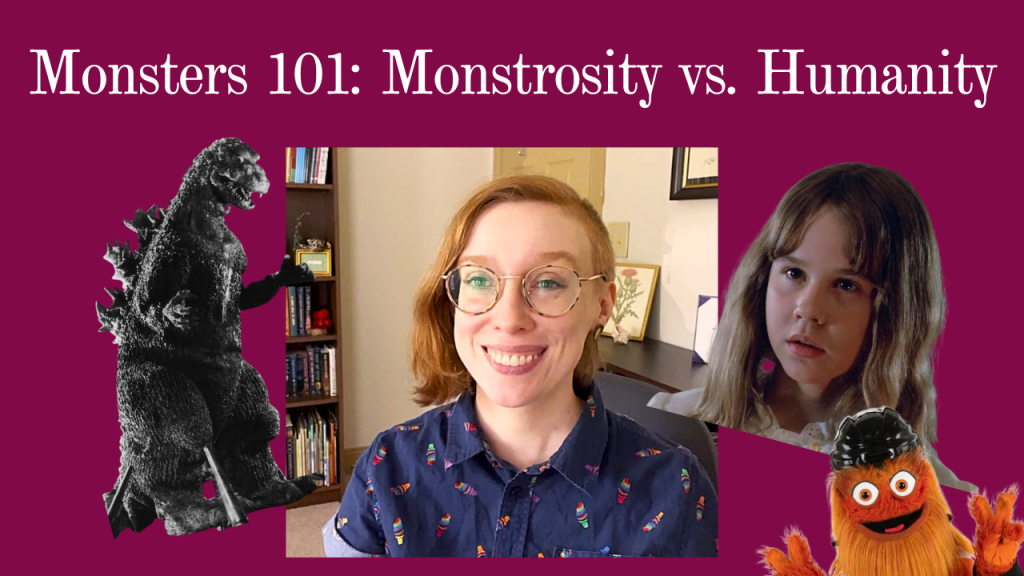
Link to video: https://www.youtube.com/watch?v=edt-nvHqoWs&t=23s
INTRO
Hello and welcome to The Monster & The Child, where Childhood Studies and Monster Studies collide! I’m Dr. Kathleen Kellett, and this video is Monstrosity 101: Monsters vs. Humans. A lot of people have spent a lot of time trying to define what it means to be a “monster,” and, in some ways, that’s a bit of a fool’s errand. As one of my favorite monster scholars, American historian W. Scott Poole, says, monsters “do not mean one thing but a thousand” (p. xiv). People use the word monster to refer to all sorts of different entities. You’ve got your classic Universal guys, a whole smorgasbord of zombie-types, eldritch jawns like Cthulhu, my lord and savior Gritty, kid-oriented fuzzy friends – and that’s just the fictional ones. (Except for Gritty, who is very, very real.) In everyday language, people use the word monster as a metaphor all the time, to describe people who’ve committed terrible violence or acted cruelly – or violated a societal taboo.
Any definition of monstrosity is going to be incomplete. It’s too big a category, and part of the whole deal of monsters is that they are hard to define. The word carries with it associations of the unnatural, supernatural, or uncategorizable. So I’m going to offer a definition in this video with full knowledge that it is not an all-encompassing definition. For one, it definitely leaves out our friendlier Sesame Street types – and I do hope to do a video about them in the future, both because that’s a pretty obvious topic for The Monster & The Child, and also because in this house we worship at the altar of Jim Henson now and forever, amen. My definition is also indicative of my cultural positionality in the Western world; human-monster relationships from non-Western cultural contexts can be much more variable than what I am about to describe. (Hopefully another future video topic.) But I do think that the definition I’m about to give is useful, because it ties together a lot of different monster types, and it allows us to see one of reasons that this category of monstrosity – whether in fiction or real life – is so powerful and emotional.
So here is my claim: monstrosity often functions as humanity’s antagonistic opposite. It is the anti-human.
What I mean by this is that, geographically, physically, or behaviorally, a monster is often imagined as actively against and opposed to acceptable expressions of human ways of being. Therefore, we can’t actually identify what is monstrous without also identifying what is human – and vice versa. So in this approach to monstrosity, a monster can’t exist in isolation. Take Godzilla. In the 1954 original Japanese film, Godzilla is a prehistoric holdover – essentially a dinosaur that never went extinct. It lived in the deep ocean, only emerging often enough to become a folkloric figure for the local population. To them, because of the potential danger it represented, it was a monster of legend – but to everyone else, unaware of its existence, it was just an animal. Just a creature like a whale or a giant squid. When they’re minding their own business away from humanity, that’s just wildlife. But when they attack humanity – when they disrupt the safety of a rule-bound human society – they become our monsters: the kraken, Moby Dick – and Godzilla. The antagonistic contact with humans is necessary for the designation of monstrosity. The word “monster” is a label that a human assigns to something based on this perception of an anti-human way of being.
Now, those of you familiar with Godzilla may be thinking, hold up. Godzilla didn’t just attack Tokyo out of nowhere. Its habitat was destroyed and its body was irradiated by nuclear testing in the ocean. It didn’t just become a monster when it acted in an anti-human way: humanity acted in an anti-Godzilla way first. And that’s the thing about a good monster story: monsters don’t just present us with imaginary things that are against us; they also reveal what happens when we break our own rules of being human. In the 1950s, Japan was still absolutely reeling from the atomic bombing of Hiroshima and Nagasaki in 1945. Godzilla was – and always should be – about nuclear trauma and dread. Humans make Godzilla anti-human by carrying out inherently anti-human weapons testing. Reading monsters as antagonistic opposites of humanity always begs the question of what happens when we – humans – don’t act like humans anymore. What do we create, and what do we become?
HUMAN CARD REVOKED
Some monster stories deal with this question very directly. In Greek mythology, the King Lycaon did some pretty bad things. This being Greek mythology, there are multiple versions of his story, but the one that Ovid told in his Metamorphoses is that Lycaon received the god Zeus as a guest. Lycaon was skeptical of Zeus’s divinity, particularly his omniscience and his immortality. So Lycaon attempted to feed Zeus human flesh, to see if the god would recognize it for what it was, and Lycaon also attempted to kill Zeus in his sleep to see if he could die. For these crimes, Zeus destroyed Lycaon’s home and turned Lycaon himself into a wolf.
Now, some of what Lycaon did wrong here is pretty obvious. All human societies have rules determining when and why other people can be killed, with pretty heavy restrictions against random murder. All human societies have rules about cannibalism, too, with many having outright unbreakable taboos around the entire practice, and even those historical societies that did have cannibalistic practices always had strict rules about the who and the when and the why. No human culture has ever been cool with just killing a guy and cooking him as a test. But, as monster stories generally are, it’s more specific than that. While there is significant overlap in some of the most basic ways that cultures define what makes a proper human, we should always be wary of true universals when discussing societal norms across time and space. If I were magically transported to Ancient Greece – which, please no – the basic rules of engagement that I would observe there would be wildly different to what I, as a 21st century American, deem acceptable. Because when I’m talking about “being human” here, I obviously don’t just mean biologically. Human is a cultural category, and we exclude biological humans from that category all the time when they are perceived to break the rules of behaving correctly in human society.
For Lycaon, one of the main rules he broke, aside from the murderin’ and cannibalism, was the rule of hospitality. Like I said, if I were in Ancient Greece, I would find a lot of their ways of life quite anti-human from my perspective, especially when it comes to things like slavery and gender requirements. People from ancient societies would similarly feel like a human in a monstrous world if they were magically transported to our time. But one of the governing structures of Ancient Greek society was the strict code of conduct around the treatment of guests. For an excellent discussion of this, see Emily Wilson’s introduction to her translation of The Odyssey, and then go ahead and read the whole translation, because it’s riveting. (Trust me, as someone who did not enjoy The Odyssey in high school, this translation will fully redeem your ninth grade suffering.) To make a long and complicated societal story almost insultingly short, the rules of hospitality were of paramount importance in Ancient Greece because travel – and therefore trade, and diplomacy and alliances, and oftentimes relationships in general – would not be safe without them. People can’t just hop a plane and get to where they’re going; they have to travel through other people’s lands and stay in their houses and trust that they will be treated with decency. Lycaon’s transgression wasn’t just against Zeus – it was against the entire fabric of society. It was against a rule that humans need in order to keep being human with each other. So Zeus’s message as he turns Lycaon into a wolf is clear: you didn’t act like a human, so you don’t get to be human anymore.
We can see, then, how the category of “monster” is not a preexisting objective state of being, but instead a value judgment. This value judgment is always going to be heavily informed by the culture that we’re a part of. Part of what a culture is is mutually agreed-upon value judgments – and, of course, categories. We humans are a pattern-seeking species, and we love to put things – and people – into neatly defined boxes. We then create institutions – schools, hospitals, legal systems – to keep these categories we’ve created stable. To be clear, this is a neutral and necessary thing. You can’t have a culture without these processes. Whether you or I as individuals agree with the ways in which these categories are formed and enforced can be determined on a case-by-case basis. I think we can all agree that the category of “host” enforced by the rule of “don’t feed your guests people and then try to kill ’em” is, like, a good cultural norm. We should keep that one. A+ to culture there. But there are plenty of obvious rules and categories that have needed change over time and continue to need change: roles defined by race, by gender, by ability and disability, etc.
What monsters can do for us is call attention to these rules and categories – both the ones we agree with and the ones we might want to change. As practically every piece of monster scholarship you’ll ever read points out, the etymology of the word monster, like demonstrate,derives from Latin roots for the verbs to reveal and to warn (Poole, 2011, p. 5). One name you’ll hear come up a lot if you dive into monster studies is Jeffrey Jerome Cohen. In 1996, he wrote his seminal essay “Monster Culture: Seven Theses,” which everyone and their dad cites and which absolutely blew my mind the first time I encountered it as an undergrad. I may or may not have a line from it tattooed on my leg. In this essay, Cohen lays out seven theses of monstrosity, though he also acknowledges that his rules are bendable and breakable, because, again, we can’t get too rigid with our definitions when it comes to monstrosity. But Cohen’s very first thesis is that “the monstrous body is a cultural body,” and therefore in order to understand any given monster, we need to examine it within the context of the specific time and place in which it was first given that label of “monster.” Cohen argues that every monster – indeed, every version of a monster type, such as vampires from Dracula to Edward Cullen – each represent anew the “fear, desire, anxiety, and fantasy” of its specific cultural context (p. 4). Understanding our collective fears, desires, anxieties, and fantasies is a pretty significant undertaking, I’m sure you’ll agree. That’s pretty much the mission statement, in one way or another, of humanistic and/or social scientific study. There are nearly as many ways to study monstrosity as there are types of monsters themselves, and students of psychology, anthropology, sociology, cultural studies, literature, media studies, and history have all taken cracks at answering the question of what makes us create, again and again, stories about our own antagonistic opposites. Importantly, scholars are not the only ones who do this. We create and spread and wrestle with monsters in oral tradition, novels, film, theater, political rhetoric, and everyday metaphor. (More on those last two in the last part of this video.)
The fact that we have so many different voices and ideas and theories in this conversation about monsters is, in my opinion, a good thing. Franco Moretti wrote an essay called “The Dialectic of Fear,” in which he discussed competing and complementary theories of horror fiction like Frankenstein and Dracula. He wound up approaching his analysis with a combination of psychoanalysis and Marxist theory, which was a pairing that he recognized was unorthodox. But he wrote that combining theoretical approaches is justified when dealing with a subject like horror and fear, because fear doesn’t just come from one place. He wrote that fear can be “economic, ideological, psychical, sexual (and others should be added, beginning with religious fear)” (p. 82). Therefore, Moretti argues it is “possible, if not obligatory, to use different tools in order to reconstruct the multiform roots of the terrorizing metaphor” (pp. 82-83). Like I said before, monsters take hold of our attention and direct it to our cultural rules and categories by breaking them. Most of the time, a lot of these rules and categories are invisible. Our social constructs are the background noise of our society: always there but not particularly noticeable unless the noise cuts out and leaves us in total silence. But once a monster brings these most important cultural underpinnings to our attention, we should seize the opportunity to understand them by whatever ways of knowing we have available to us. Monsters aren’t constrained by boundaries, so our thinking shouldn’t be, either.
CHILDREN VS. HUMANS
With that said, we do all have our own areas of expertise or particular interest, and as the title of this channel suggests, mine is Childhood Studies. So let me provide another example of some of these ideas about monstrosity with a monstrous child this time. Let’s look at Regan from The Exorcist. I’m assuming everyone’s at least familiar in passing with this possessed preteen, but for those who haven’t worked up the courage to tackle such a notorious horror classic yet, here are the basic facts. The entity who possesses the 12-year-old Regan is the demon Pazuzu, who is actually a real mythological figure. Pazuzu was an ancient Mesopotamian wind-demon – ancient Southwest Asian demons frequently represented forces of nature. He had many evil and destructive proclivities, but also some protective functions, particularly for pregnant women. Subsumed into the Catholic storytelling of The Exorcist, Pazuzu no longer retains this moral complexity: he is just all the way, entirely bad, and his presence threatens Regan’s life and the lives of everyone around her. Two priests, the doubting Father Karras and the long-time exorcist Father Merrin, are the last resort of Regan’s mother, the successful actress and single mom Chris MacNeil. Pazuzu talks through Regan’s mouth in a deep, guttural voice, and he covers her skin with sores. While he inhabits Regan’s body, he forces it to do all sorts of disturbing things, such as urinate on the floor, projectile vomit green goo, and violently and bloodily do things with a crucifix that if I were to describe further might get me in trouble with YouTube, and I’ve only just started here, so I won’t.
One popular way of analyzing monsters is by using the philosopher and literary critic Julia Kristeva’s work on the concept of abjection. Kristeva defines the abject as, well, the undefinable. We can only describe it by referring to what it is not: it is not the subject, the self, the (ideally) stable identity. The abject is not an object, either, because an object, though it’s also separate from the subject, can be defined pretty easily and comfortably in contrast to the subject. We’d like it if we could do the same with the abject, but unfortunately, the abject is simultaneously closer and more opposed to everything that we are. It is waste, violence, death, and rot, the parts of human experience that “if I acknowledge it, annihilate me” (Kristeva, 1984, p. 2). One example that Kristeva gives is the skin that forms on a pot of boiling milk. It’s the stuff that makes you gag – but while we want to escape it, a lot of times we can’t. I mean, waste and death? Can’t get much more human than that. But these are some of the things our rules, our categories, help us to, if not avoid, then at least contain and quarantine, so that we can maintain at least a little plausible deniability.
Monsters tend to trample all over that deniability. That’s why they so often embody the abject. The Pazuzu-infested Regan certainly does. She makes visible all those things like vomit, urine, blood – especially blood associated with sexuality. If the abject is, like Kristeva says, diametrically opposed to the stability of the self, then abject monsters like Regan can easily be read as diametrically opposed to the human. It’s not us, and it attacks us: our antagonistic opposite, again.
But as with Lycaon, Regan is more specific than that. Just like everyone agrees that sneaky cannibalism is a bad idea, we also can assume that a distaste for pea soup vomit is one of those very few universals that I mentioned earlier. So sure: some good, baseline level monster stuff going on here. But Regan is not just a possessed person. She’s a possessed child. A possessed girl. A possessed pubescent girl. When a monster is associated with a particular type of person, we can be sure that it will offer some insights into the ways in which we – and here when I say we, I mean Americans in the 1970s – define that category. Not all people in a given culture operate under the same rules, after all. The rules that govern not only the behaviors but the very definition of “12-year-old girl” are extremely particular. The ways in which the possessed Regan breaks these rules reveal a lot about how “humanity” as a cultural concept relies on how we govern gender, sexual development, family units, and childhood itself.
So what is a white 12-year-old American girl supposed to be, in both the 1970s and now? Ideally, still more of a child than an adult; her pubescent sexuality should be invisible, contained, delayed. She should be happily and obediently within her place in a nuclear family – but, uh-oh, we’ve already established that Regan’s dad is absent. (We can also, of course, read potential indictments of the working, show biz-y Chris: is she performing the category of “mother” the way she’s supposed to?) So we can see Regan’s vulnerability to falling out of her box, out of her category, out of the definition of humanity. Pazuzu, a male entity visually portrayed by two female actors, subverts Regan’s nascent puberty into aggressive, gender nonconforming, violent sexuality. We see what a 12-year-old girl is supposed to be through Pazuzu transforming her into everything she is not supposed to be.
The throughline, of course, is innocence. I’m going to talk about the construction of childhood innocence in much, much, much more depth in my next video and a bunch of other videos I have planned, but this one is still Monsters 101, not Childhood 101, so I’ll keep it brief here. But it almost goes without saying that childhood and innocence are linked concepts – at least in Western cultures within the past few centuries. There are a bunch of components to what innocence means, but one of them is the idea of moral purity. The notion that children are morally pure – that they are better people than adults – is deeply ingrained certainly within my own culture. In fact, when I tell people what being a Childhood Studies scholar is all about, I’ve had people get offended when I say that it involves questioning and analyzing things like “childhood innocence” as a social construction. Sometimes people take the mere notion that such a thing is not a natural and self-evident truth as an insult to all kids – and, if you think about it, all humans. Because it’s a pretty comforting idea about humanity, isn’t it? That we all at least start out pure? But it also begs the question of when that goes wrong, and the changes of puberty, of adolescence, is a period that collects a lot of anxiety. Regan’s possessed monstrousness calls attention to that – the absence of innocence in a body that we want to hang on to innocence for as long as possible. That is very effectively scary. It is absolutely a monstrosity that is positioned antagonistically against humanity – and it helps us learn about how the overarching category of “humanity” relies upon the maintenance of the smaller categories that we sort people into, such as “childhood.”
THE MONSTER METAPHOR
Okay, so like I said, more on all that childhood stuff later, and by later I mean for the entire rest of this channel’s existence on YouTube. But the last part of this topic that I want to explore in this video is how the understanding of the anti-human monster functions outside of fiction. As I said before, people use the term “monster” all the time, often to describe other humans who we think are doing a very bad job of human-ing. However, even within a shared cultural context, not all people are going to agree on their definitions of monster or human. Look at the times we are currently all stuck in together. So what are some of our options when it comes to imagining real humans as somehow opposed to “humanity”? I alluded before to the phenomenon of equating monstrosity with identities and categories that are marginalized in a given culture. This plays out both in fiction and reality, in a co-constructive, self-reinforcing cycle. W. Scott Poole’s (2011) survey of American monster history touches upon subjects like the association of enslaved Africans with cannibals – revisiting one of our taboos from earlier – and the deviant sexuality of vampirism with the women’s rights movement. On top of this, scholars have explored monstrous mental illness, gender, and race – I have some links to a couple examples with the rest of the works cited in the description (Papps, 2019; Oswald, 2013; Thomas, 2019). Dana Oswald (2013), writing about gender and monstrosity, explains that monsters aren’t only warnings, but, when viewed in the right light, also roadmaps: “If even human bodies transgress socially constructed categories of gender, then monstrous bodies articulate the means by which human bodies can do so” (p. 346). So we can see that marginalized monsters can serve different functions for different people. To those with power and privilege, these monsters cause fear as they threaten the stability of their positions at the top of the social hierarchy. To those who live on the margins due their identities, monsters and monster stories can provide guidance or even community.
However, marginalized monsters are not the only types of monsters. David McNally (2011), in his book Monsters of the Market, analyses monstrosity as a metaphorical tool for critiquing capitalism. If you’re watching this on Youtube dot com, you probably live within a capitalistic system, which – much like the other rules and categories that govern our lives – functions by remaining invisible and taken-for-granted, until people can’t really imagine any other way to organize society. McNally argues that, since monsters are such a stark and emotionally heightened concept literally defined by their weirdness and rule breaking, they’re really well positioned to make the familiar strange and the invisible visible, in a process that he calls “estrangement effects” (p. 6). When used in this way, monsters can signify the anti-humanity elements of the systems in which we all live. It’s important to remember that monstrosity is a shared language; as McNally says, “subaltern groups in capitalist society attach images of monstrosity to oppressive powers, not just subversive ones” (p. 12). In other words, who and what a monster represents will depend on the monster story’s narrator.
At this point, let me provide a quick crash course on metaphor, since outside of fiction that deals with literal supernatural beings, that’s what monsters are. We do, on one level, know when we refer to, for example, a serial killer as a monster that they’re not actually literally not human. But we use this terminology, this concept, because it conveys a set of ideas succinctly and emotionally. There is a lot of scholarship on metaphor, much of it in neurolinguistics, which is quite beyond my area of expertise. But I can explain some of ideas that can help us understand why we’re collectively so attached to the monster metaphor.
In the 1980 landmark text Metaphors We Live By, George Lakoff and Mark Johnson define metaphor, pretty straightforwardly, as “understanding and experiencing one kind of thing in terms of another” (p. 5). But to them, metaphor is not just a linguistic phenomenon, but rather evidence of a much deeper system of understanding and relating to the world. They call this phenomenon “conceptual metaphor” (p. 3). They argue that metaphor is grounded in experience, which in turn is grounded in culture, and that all three – metaphor, experience, culture – are co-constructive. In other words, they all help contextualize and make meaning out of one another. Lakoff and Johnson use the conceptual metaphor ARGUMENT IS WAR to demonstrate how this works. A ton of the ways that we talk about argument in English and many other – but definitely not all – languages uses military metaphor. Arguments are won or lost, ground is gained if an opponent starts to agree, people are locked in a battle of wits, etc. These metaphors, Lakoff and Johnson argue, manifest in the ways we understand and therefore carry out the act of arguing. It’s combative, all-or-nothing, with a clear victory and defeat. But this is still a metaphor. It’s explaining one thing by comparing it to another, different thing. Argument could be understood in other ways; war is not a perfect or complete analogy. As much as a metaphor reveals some aspects of a concept, it hides others. In this case, ARGUMENT IS WAR hides the potential of cooperation in problem-solving (Lakoff & Johnson, 1980, p. 10). Simplification — and sometimes oversimplification — is a major function of metaphor. I think this aspect of Lakoff and Johnson’s theories of conceptual metaphor provides a very useful framework for understanding both the benefits and limitations of a metaphorical construct like monstrosity.
Monsters are heightened and exaggerated creatures, and we live in heightened and exaggerated times. The presidencies of Donald Trump are marked by a lot of hyperbolic scapegoating. A 2020 Daily Beast article by Pilar Melendez details the on ways that Trump in his first campaign and administration specifically used the monster metaphor to describe perceived enemies as wide-ranging as immigrant populations, natural disasters, and Kamala Harris – before he even ran against her (Melendez, 2020). Trump also often uses similar metaphors like “animals” or terminology associated with the monster metaphor like “evil” as ways of associating concepts and people with an anti-human antagonistic agenda. When he’s talking about actual humans, the use of this metaphor is dehumanization at its most literal level – it’s not only that someone is not human, but they’re also against all humanity. It is a good way of justifying extreme force. But, as David McNally reminds us, conservative or reactionary politicians are not the only ones who use monster metaphors. In 2018, Erin Cassese published a study on the ways in which both 2016 presidential campaigns employed monster rhetoric. Trump himself has been described with monster metaphors frequently political speech and reporting and media like political cartoons (Cassese, 2018). Lord knows I’ve been known to use it. That tells me – and you – something about how I define humanity. There are rules and categories of being human that I feel like Trump breaks, and breaks badly. I mean, Lycaon was disqualified from being human for, among other things, murder, and many of the Trump administrations’ past and present policies either risk or have been proven to cause unnecessary death. So that’s a pretty basic one. But, as Lakoff and Johnson’s theories demonstrate, metaphors reveal some aspects of a concept – or person – and hide others at the same time. When I use the monster metaphor, what gets hidden? What might I miss? It’s comforting to call a harmful person a monster, because of the clear antagonistic distinction between monstrosity and humanity. But that distinction only exists in the realm of the conceptual. In reality, stripped of metaphor, it really is all just humanity – and we shouldn’t allow our metaphors to let us hide from that.
PARTING THOUGHTS
All right, so that last part was perhaps a bit of a downer, but hopefully at least a thought-provoking one. I’d love to hear your examples of ways in which this understanding of a monster as an anti-human antagonist play out, whether in fiction or in real life. I’d also be super interested in your thoughts about other ways of defining or understanding monstrosity. Like I said back at the beginning, this is not the only way to approach monsters; it’s just one that I personally find useful and fascinating. If you did as well, I would love it if you give this video a like, subscribe to my channel, and/or add a comment down below. Make sure to check out the sources in the description. In my next video, I’m going to discuss the roles of monster, victim, and hero within the structure of a monster story, and how all three archetypes depend upon one another to make sense. We’ll also talk more about how that pesky figure of the child fits into those three roles, as well. But in the meantime, thanks so much for watching this video, and I hope to see you next time for more monstrous food for thought.
 Kathleen Kellett